MBSE
Technology definition
With over 30 years of expertise in mechatronics the company transforms its disciplinary know-how into coherent and capitalizable technological building blocks through a systems approach. MBSE makes it possible to formalize the functions, interfaces, assumptions, and trade-offs that characterize a given technology, independently of a single application. This model-based governance makes the technology traceable, reproducible, and distinctive, while facilitating its evolution towards new uses. System engineering optimizes the technology itself, not just the final product, by guiding architectural choices through key performance indicators (mass, volume, cost, efficiency, reliability, etc.). Thus, MMT does not simply deliver solutions, but develops and promotes robust and proven technologies aligned with the company intellectual property and proof of concept business model.
Technology characteristics
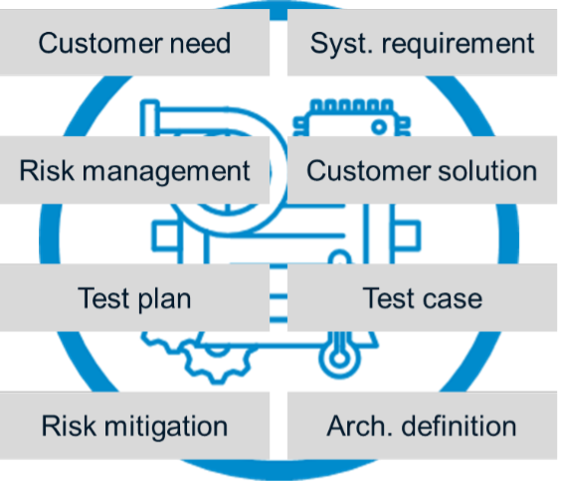
The implementation of Model-Based Systems Engineering (MBSE) relies on a coherent set of technological characteristics that structure, secure, and accelerate the development of innovative concepts, from their initial definition to their demonstration through proof of concept. The approach starts with a formal analysis of stakeholder requirements, ensuring full traceability between needs, system functions, and architectural choices. This end-to-end traceability is a core technological feature: it makes design rationales explicit, demonstrates the consistency and robustness of the concepts, and strengthens their value from an intellectual property and technology ownership perspective.
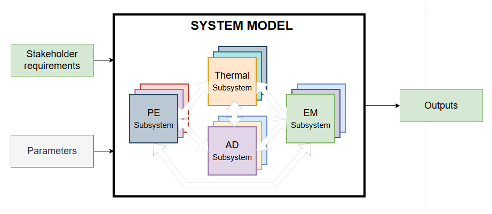
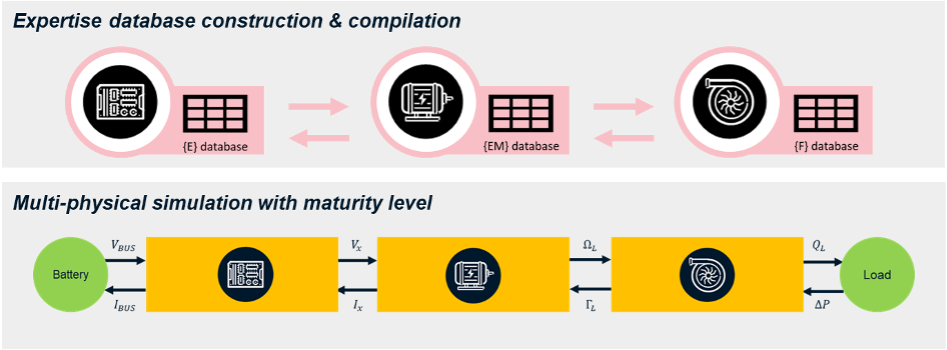
System models are then developed across multiple levels of fidelity, with speed-to-accuracy ratios adapted to the targeted level of technological maturity. Low-granularity models enable fast exploration of the solution space and early identification of promising system architectures, while higher-fidelity models support the progressive maturation of the concept toward A-sample prototypes. This continuity in modeling reflects the scalability, reusability, and evolvability of the technology, while enabling knowledge capitalization in the form of modular and reusable technological building blocks.
From the earliest development stages, the MBSE framework integrates virtual and physical validation means such as Rapid Control Prototyping (RCP), Software-in-the-Loop (SIL), and Hardware-in-the-Loop (HIL). These tools enhance the intrinsic testability of the technology by allowing system behaviors, interfaces, and performance to be pre-validated through simulation before physical prototyping. By front-loading validation activities, this approach reduces technical risk, shortens development cycles, and enables controlled exploration of system trade-offs. For customers, the benefits are tangible: reduced time-to-market, improved cost and performance control, earlier and more secure technical decision-making, and access to mature, demonstrated technologies that can be directly exploited or leveraged within an innovation strategy driven by proof and intellectual property.
OUR TECHNOLOGIES